
Social Science and Business Books
"Understanding Organizations" introduces readers to the key principles of theorizing, designing, and managing organizations. Key concepts are taken from economics, institutionalism, and evolutionary theory to explain the relationship between organizations, their members, and the broader society in which organizations operate.
For Table of Contents and Preface see:
Creative activity typically takes place within a broader environment. This volume includes both conceptual and empirical studies on industries, firms, clusters, and projects as the organizational context in which the creative process evolves and produces consequences for economic and social development.
The papers in this collection examine a range of issues regarding the changing social structure of advanced capitalist societies. These include developments in the modern business enterprise, interest representation, and the organization of the workplace.
Out of print
Two types of entrepreneurs are discussed, with reference to their role in economic and social development. As demons, they are seen as a destructive element in society, leading to economic exploitation and social marginalization. As creators, they are seen as an innovative factor in economic activity, contributing to economic revitalization and new development.
Business networking is considered a vital strategy for survival in volatile markets. This volume addresses the opportunities and limitations of institutional interventions that are designed to promote business networks, with a special view to regional economic development.

Die Soziologie sei nicht leicht zu verstehen, sagen die Kritiker. In diesem Buch werden die zentralen Denkmodelle in der Soziologie anhand aktueller Themenbereiche in leicht verständlicher Sprache vorgestellt, um Lesern einen ersten Einblick in die Arbeitsweise von Soziologen zu geben. Die Argumente werden hierbei vom Feld schmucklosen, nüchternen Denkens in der Wissenschaft auf das Feld der unterhaltsamen Ironie verlegt.
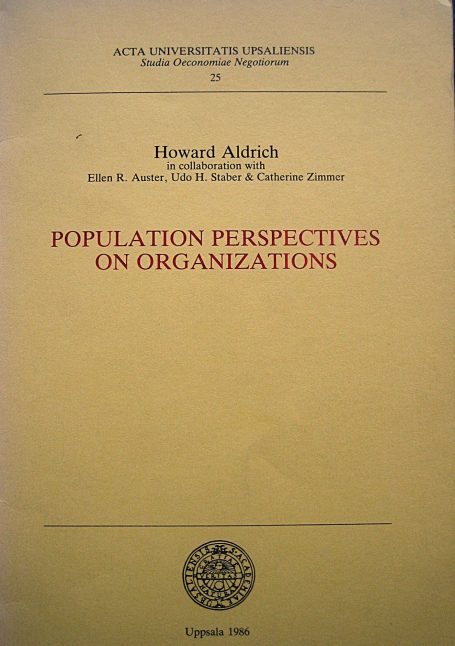
The essays in this collection propose an ecological and population perspective on organizations and industries. Among other things, population thinking highlights the role of chance in the development of organizations, with special reference to the boundaries within which generalizations can be made about individual behavior in and of organizations.